Last weekend was a reminder that I can do hard things. That all it takes is telling myself I can do it.
Pickup was at 6:50 a.m., where—along with fifteen other strangers—we boarded a shuttle bus and headed out of Antigua to the department of Chimaltenango (departments are what we would essentially refer to as “states” in the U.S.). The drive was slated to take about forty-five minutes. However, it’s Guate—and getting into a car, a tuk tuk, or a bus is always an adventure.
This time, I had a front-row seat to my first accident. Our shuttle bus went to pass a pickup truck—unbeknownst, apparently, to the motorcyclist who was riding between our bus and the truck. As we started to pass, the motorcyclist did too and slammed right into the side of the shuttle bus—directly against the window where I was sitting. The motorcycle came crashing down, the driver sprawled in the middle of the road.
The driver of the shuttle bus was completely unfazed. He got out, helped the motorcyclist up, while a few other cars that had stopped helped move the bike to the side of the road. Within three minutes, we were back on our way. No police. No exchange of information. Nothing.
I asked my Spanish teacher about it a few days later. She said it’s up to the people involved in the accident to determine at that moment who was at fault and to come to an agreement about who pays for what. It would have seemed wild if I hadn’t already been in other countries where road accidents are just par for the course—Vietnam, Sri Lanka, Thailand, to name a few. Every country has its own way of handling things, and they’re often night-and-day different from the States.
Even though I wasn’t the one who caused the accident and no one was injured, I could feel my heart pounding out of my chest—and it didn’t stop.
If anything, the adrenaline only continued once our group sat down to enjoy a pre-climb breakfast, met our guides, and were essentially told that if by hour one we were struggling or feeling sick (altitude sickness is fairly common), we’d have to turn back.
I thought, No way—that won’t be me.
But my heart was still pounding, and I couldn’t help thinking, What if that is me?
If you’re still wondering, “WTF is Acatenango“,– keep reading.
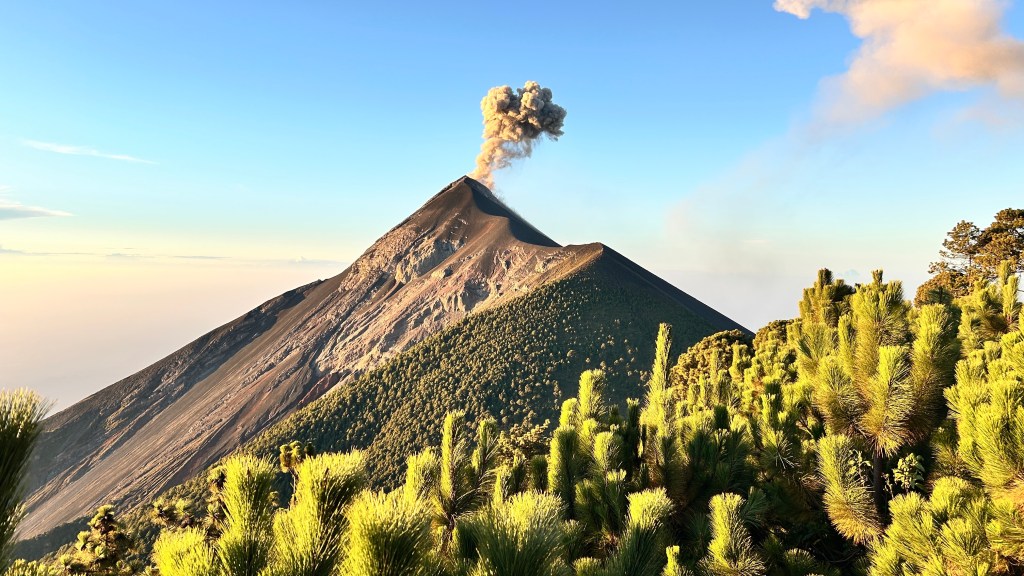
Mount Acatenango is one of Central America’s tallest volcanoes, standing at just under 13,000 feet (3,976 meters). It sits about an hour outside of Antigua and shares a ridgeline with Volcán Fuego—one of the most active volcanoes in the world.
The hike itself is no joke. The trail gains nearly 5,000 feet in elevation, moving through farmland, cloud forest, and volcanic rock before reaching base camp. What makes Acatenango so special isn’t just the climb—it’s the front-row seat it offers to Fuego’s near-constant eruptions, especially after dark.
Before we started our trek, I met a couple—Danica and Wilhelm from Belgium—on day three of what is to be a two-year travel adventure. I couldn’t help but tell them how excited and proud I was of them for embarking on something like that. Kindred spirits, for sure.
I also touched base with another couple from Mexico that I’d met on the bus. Miguel, the husband, seemed just as nervous as I was—but neither of us had the nerve to say it out loud.
With my small daypack stuffed to the brim with three liters of water, snacks, and all the cold-weather gear I’d brought with me to Guatemala, I grabbed my rented trekking poles, and it was time to start.
Unbeknownst to me at the time, our group had a fairly private entrance to Acatenango. I’d seen videos from days prior where so many people were on the trail that it caused intense backups going both up and down. For whatever reason, the only other people we encountered were a group from the same hiking outfit on their way down and a few locals who looked like they hiked Acatenango for fun.
I started near the front of the pack. With one guide for every six people, I felt pretty comfortable where I was. But after the first twenty minutes of elevation gain—nothing but switchbacks and scrambling over rocks and volcanic soil—I started to fall back.
At first, it was just letting a few people pass, then carrying on. Then it was a few more. Until finally, I found myself at the very back of the group, hanging out with one other girl and a guide.
I was struggling.
It wasn’t body fatigue—my legs were fine. It was exhaustion. Maybe the thin air. Maybe the realization that my cardiac health wasn’t where I thought it was. Whatever it was, it forced me to question what the hell I was doing. Everyone else seemed to be trucking along just fine.
I kept repeating to myself: One step at a time. This isn’t a race. You’ll get there when you get there.
One of the guides—already hauling three other backpacks—noticed my struggle and offered to take mine. I fought him hard, insisting I could do it, but he insisted more. He carried it for about five minutes before we reached our break area.
I wish I could say it made all the difference in the world to not be carrying thirty pounds on my back, but the truth is, the difference was barely noticeable. Now I just felt like I didn’t have an excuse to still be moving so slowly.
But I pressed on. And so did everyone else.
After two and a half hours of steady elevation gain, we took a twenty-minute rest. The guides gleefully told us the hardest part of the hike was over—ten more minutes uphill and then the trail would level out.
I thought, Okay, Allison. Ten minutes. You’ve got this.
Lie.
Those last ten minutes felt like slogging through mud. My legs were moving, but it didn’t feel like I was getting anywhere. I wasn’t alone—several other climbers had fallen back—but the guide was right. After about ten minutes, the trail did level out.
Suddenly, I felt completely at ease—like I was on a gentle stroll through the mountains. I caught my breath for the first time in what felt like three hours and finally started to enjoy the walk.
Sure, there were still a few small inclines and dips, but I was eternally grateful that the hardest part of the climb was behind me.
Nearly four hours after we started, we slowly trickled into base camp. It’s hard to put into words how captivating the view was. The adrenaline was still coursing through me, and it took a while before I could really sit down and take it all in.
About thirty minutes later, I dropped my bag in the little cabin I was sharing with another couple, pulled up a chair outside the door, and finally exhaled.
I was lucky to be next to Danica and Wilhelm, and soon we were joined by a couple from Germany—Manu and Alison. We spent the next two hours passing around a few joints, laughing about what we’d just accomplished (and how much harder it was than expected), and admiring the view.
There was an optional hike to Fuego for sunset—a three-hour round-trip addition. Even before the climb, I knew it wasn’t happening for me. After that morning’s hike, I knew for certain. And honestly, I was more than content to just sit and be.
While most of the group geared up to go, Manu and Alison also stayed back. The three of us spent the next few hours talking about life and travel. They’d been on the road for nearly four years, on and off, and in that moment I realized I had found the people I’d always hoped to meet while traveling.
People who get it.
People who understand what it means to live with nothing but a bag on your back. To get “stuck” somewhere and fall in love with the culture and people who give a place its identity. People who don’t conform to what society tells them they should want, and who have worldviews shaped by lived experience—not just their tiny corner of the world.
I may never cross paths with them again, but that night reminded me why I travel.
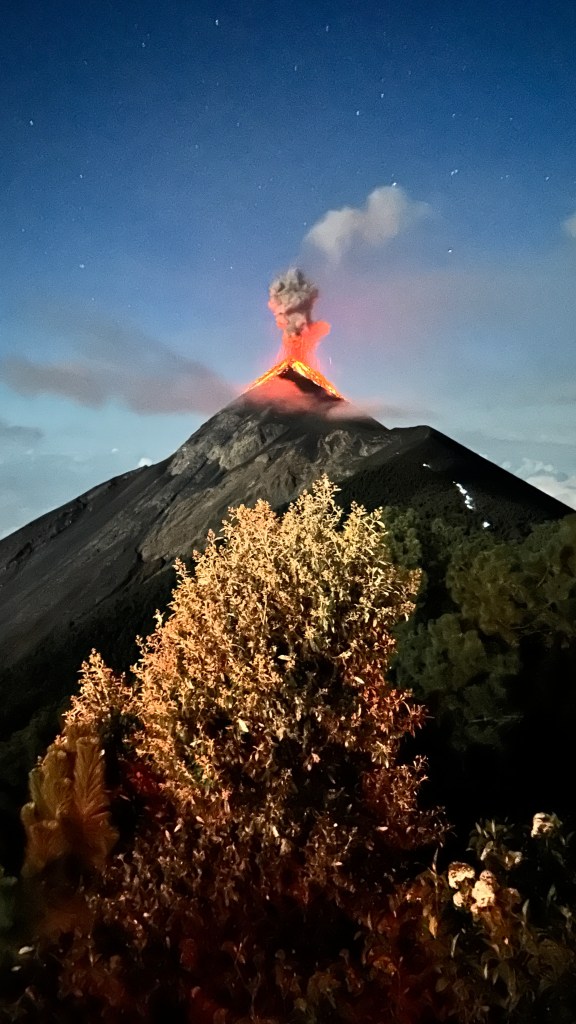
As the sun set, Mount Fuego really began to put on a show. It had been erupting all day, but once darkness fell, it started to glow. Every fifteen minutes or so, it erupted—and every time, in unison, all you could hear from base camp was: “Wooow.”
By then, the weather was bitterly cold. I layered on everything I had—gloves, two pairs of socks, a wool hat, two sweatshirts, a base layer, and a puffer jacket—and I was still freezing. No surprise to anyone who knows me.
I’d love to say I curled up and was lulled to sleep by the sounds of the volcano erupting, but that would be a bold-faced lie.
The cabins were rustic at best. No heat. No electricity. Just four walls and a roof. Despite a mattress, two blankets, and a sleeping bag, warmth never came. It was a restless night—but one I expected.
At 3:45 a.m., there was a knock on the door for anyone attempting the sunrise hike to the summit. I’d considered it vaguely before the climb, but after day one—and hearing the guides say it was even harder—I made a decision that marked real growth for me.
The old Allison would have gone anyway. To check the box. To get the photo. To say she did it.
This Allison stayed put. And felt absolutely no guilt about it.
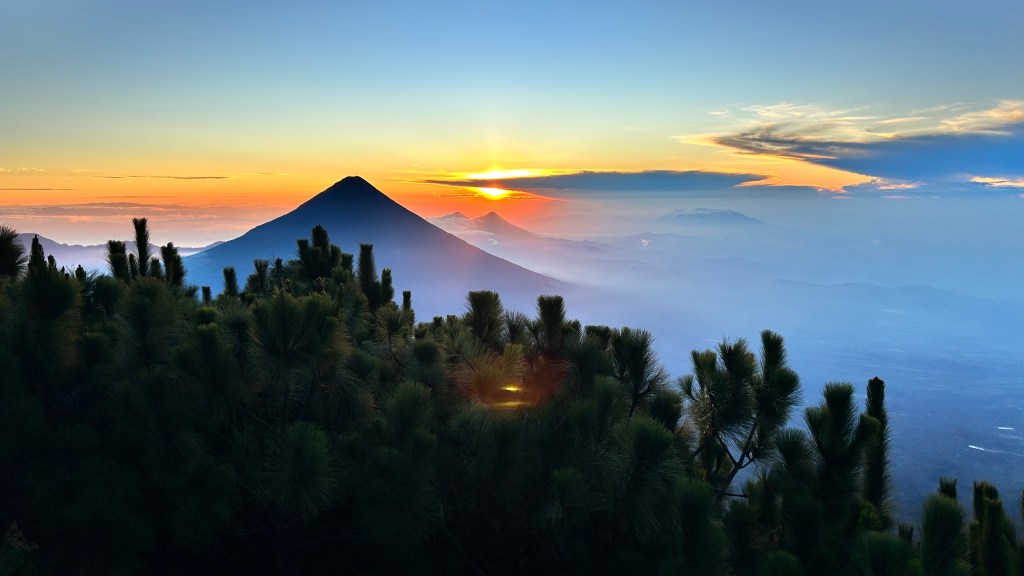
From base camp, we still had an epic view of the sunrise over Mount Agua. There’s something magical about sunrise—the stillness, the quiet, the feeling of a new beginning. Watching it from Acatenango left me in awe.
After sunrise, tea, and a slice of banana bread, it was time to head back down. Aside from slipping, sliding, and essentially skiing down volcanic gravel, the descent was a breeze compared to the day before.
Near the bottom, I stopped in an open field and turned back to look at the mountain.
Tears filled my eyes.
During the hike, thoughts of Mike drifted in — not in a heavy way, but in a quiet, unexpected one. We did a lot of hard climbs together years ago, and somewhere along the trail I could hear his old words of encouragement echo back to me.
What surprised me most was how peaceful that felt. Not sad. Not longing. Just grateful. Those experiences shaped how I move through the world now — how I travel, how I push myself, how I keep going when things get hard.
And this time, the voice urging me forward was ultimately my own.
In that moment, I said to myself: Allison, you’ve done hard things before. You can do hard things now. And you can do hard things on your own.
Yes, the guides were there. Yes, the group supported each other. But in the end, I pushed myself. I didn’t quit. I didn’t turn back.
If this hike isn’t an analogy for my life over the past decade, I don’t know what is.
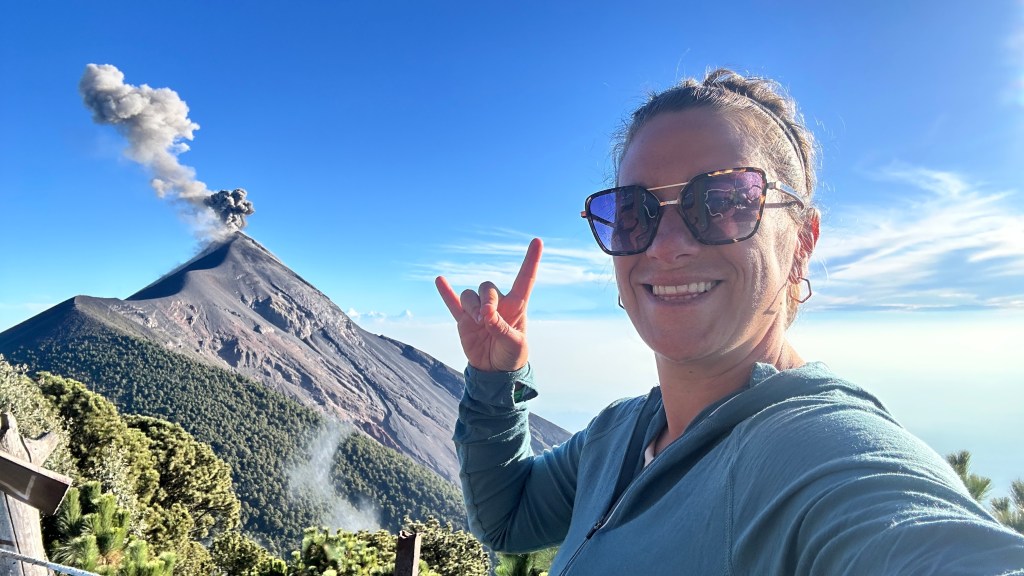
So fuck yeah—I climbed Acatenango. I made it up and back down in one piece (you’re welcome, Mom). And I’m damn proud of myself for remembering something I clearly needed to relearn:
You can do hard things.
-A


 One Life One Encounter
Leave a comment